Stable yields achieved under multiple stressors: Demonstration of salt-tolerant rice cultivation technology in coastal saline soils succeeds in Wanning, Hainan
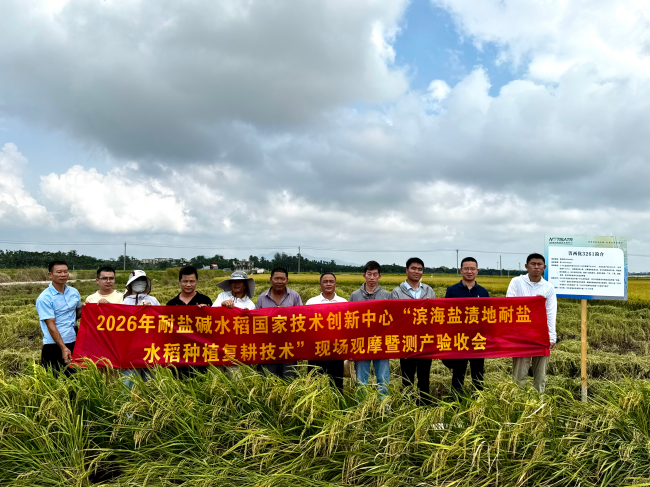
The National Innovation Center for Salt-Tolerant Rice conducted trial plantings of salt-tolerant rice varieties on abandoned saline-alkali land along the coast of Wanning, Hainan. The average yield reached 436.9 kg per mu, demonstrating stable production even under multiple stress conditions during the rainy season.
On 9/22, the National Innovation Center for Salt-Tolerant Rice (hereinafter referred to as the "Center") held a field demonstration and yield verification meeting on coastal saline-alkali rice cultivation techniques in Hele Town, Wanning City.Experts from the Hainan Academy of Agricultural Sciences, Nanjing Agricultural University, Hainan University, and the Wanning City Agricultural Technology Extension Center conducted a field inspection and yield assessment at the demonstration site for "Coastal Saline-Alkali Land Salt-Tolerant Rice Planting and Reclamation Technology" by the National Innovation Center for Salt-Tolerant Rice in Wanning.Based on the yield assessment by the expert group, the demonstration site achieved an average yield of 436.9 kg per mu, marking a breakthrough in stabilizing production of salt-tolerant rice on coastal saline-alkali land in Hainan under multiple stress conditions during the rainy season.
The demonstration plot covers a total area of 85 mu. Previously abandoned due to long-term salinization from seawater intrusion, it is classified as moderately to severely saline-alkali land in coastal areas. Even with forced cultivation, yields remain low. This season coincides with Hainan's rainy period, characterized by severe pest and disease outbreaks, seawater intrusion, and frequent typhoons. The combination of these multiple adversities further increases the difficulty of achieving stable production.To address key challenges in coastal saline-alkali rice cultivation—such as poor survival, uneven growth, and low yields—the National Innovation Center for Salt-Tolerant Rice has developed a comprehensive farming system. This approach integrates high-quality, disease-resistant, salt-tolerant rice varieties with coordinated underground physical-chemical remediation and above-ground physiological regulation, supported by advanced agronomic practices. The system promotes full-scale replanting and reclamation of coastal saline-alkali lands, restoring land productivity and expanding arable area.Under the compounded stresses of the rainy season, the salt tolerance, disease resistance, lodging resistance, and yield stability of the demonstration variety Qingliangyou3261, along with its adaptability to planting and replanting technologies, were thoroughly validated.The expert panel noted that the technology demonstration yielded significant results, providing effective technical support for cultivating saline coastal lands. They recommended expanding the demonstration scale and strengthening promotion efforts.
The successful stable yield of this Wanning demonstration under multiple stressors during Hainan's rainy season follows the high-yield results from a 100-mu heavy saline-alkali field in Ledong on 6 5 (average yield: 476.69 kg/mu) and a large-scale application across 1,000 mu of coastal saline-alkali land in Jiangmen, Guangdong, on 7 17 (average yield: 408.6 kg/mu). This marks another successful deployment of salt-tolerant rice cultivation technology for reclaiming coastal saline-alkali lands.Demonstrations in Ledong, Jiangmen, and Wanning have validated the applicability of this technology system across varying salinity levels, planting seasons, and scales. This also highlights the National Center for Salt-Tolerant Rice's leadership in breeding salt-tolerant varieties, integrating supporting cultivation techniques, and promoting their adoption.
Coastal saline-alkali lands are a critical reserve of arable land with significant potential for reclamation.Wanning's demonstration project successfully withstood the challenges of complex adverse conditions during the rainy season, providing robust technical support for developing and utilizing abandoned saline-alkali lands along the coast, expanding grain production space, and enhancing comprehensive grain production capacity.Next, the National Center for Salt-Tolerant Rice Innovation will leverage its role as a national technological innovation platform. Guided and supported by ministries and agencies including Agriculture and Rural Affairs and Science and Technology, it will strengthen collaboration with technology extension services, research institutions, and production and operation entities. The center will continue to optimize technologies, conduct multi-site demonstrations, and provide training across various types of coastal saline-alkali lands. It aims to accelerate the development of scalable, replicable salt-tolerant rice cultivation techniques, contributing scientific and technological solutions to large-scale reclamation of coastal saline-alkali lands and ensuring national food security.